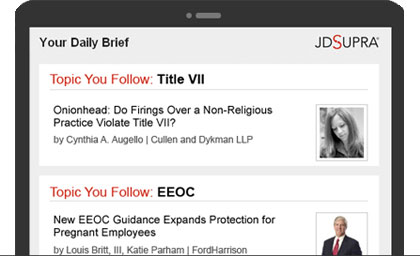
"My best business intelligence,
in one easy email…"
JD Supra Privacy Policy
JD Supra is a legal publishing service that connects experts and their content with broader audiences of professionals, journalists and associations.
This Privacy Policy describes how JD Supra, LLC ("JD Supra" or "we," "us," or "our") collects, uses and shares personal data collected from visitors to our website (located at www.jdsupra.com) (our "Website") who view only publicly-available content as well as subscribers to our services (such as our email digests or author tools)(our "Services"). By using our Website and registering for one of our Services, you are agreeing to the terms of this Privacy Policy.
Please note that if you subscribe to one of our Services, you can make choices about how we collect, use and share your information through our Privacy Center under the "My Account" dashboard (available if you are logged into your JD Supra account).
Collection of Information
Registration Information. When you register with JD Supra for our Website and Services, either as an author or as a subscriber, you will be asked to provide identifying information to create your JD Supra account ("Registration Data"), such as your:
- First Name
- Last Name
- Company Name
- Company Industry
- Title
- Country
Other Information: We also collect other information you may voluntarily provide. This may include content you provide for publication. We may also receive your communications with others through our Website and Services (such as contacting an author through our Website) or communications directly with us (such as through email, feedback or other forms or social media). If you are a subscribed user, we will also collect your user preferences, such as the types of articles you would like to read.
Information from third parties (such as, from your employer or LinkedIn): We may also receive information about you from third party sources. For example, your employer may provide your information to us, such as in connection with an article submitted by your employer for publication. If you choose to use LinkedIn to subscribe to our Website and Services, we also collect information related to your LinkedIn account and profile.
Your interactions with our Website and Services: As is true of most websites, we gather certain information automatically. This information includes IP addresses, browser type, Internet service provider (ISP), referring/exit pages, operating system, date/time stamp and clickstream data. We use this information to analyze trends, to administer the Website and our Services, to improve the content and performance of our Website and Services, and to track users' movements around the site. We may also link this automatically-collected data to personal information, for example, to inform authors about who has read their articles. Some of this data is collected through information sent by your web browser. We also use cookies and other tracking technologies to collect this information. To learn more about cookies and other tracking technologies that JD Supra may use on our Website and Services please see our "Cookies Guide" page.
How do we use this information?
We use the information and data we collect principally in order to provide our Website and Services. More specifically, we may use your personal information to:
- Operate our Website and Services and publish content;
- Distribute content to you in accordance with your preferences as well as to provide other notifications to you (for example, updates about our policies and terms);
- Measure readership and usage of the Website and Services;
- Communicate with you regarding your questions and requests;
- Authenticate users and to provide for the safety and security of our Website and Services;
- Conduct research and similar activities to improve our Website and Services; and
- Comply with our legal and regulatory responsibilities and to enforce our rights.
How is your information shared?
- Content and other public information (such as an author profile) is shared on our Website and Services, including via email digests and social media feeds, and is accessible to the general public.
- If you choose to use our Website and Services to communicate directly with a company or individual, such communication may be shared accordingly.
- Readership information is provided to publishing law firms and companies and authors of content to give them insight into their readership and to help them to improve their content.
- Our Website may offer you the opportunity to share information through our Website, such as through Facebook's "Like" or Twitter's "Tweet" button. We offer this functionality to help generate interest in our Website and content and to permit you to recommend content to your contacts. You should be aware that sharing through such functionality may result in information being collected by the applicable social media network and possibly being made publicly available (for example, through a search engine). Any such information collection would be subject to such third party social media network's privacy policy.
- Your information may also be shared to parties who support our business, such as professional advisors as well as web-hosting providers, analytics providers and other information technology providers.
- Any court, governmental authority, law enforcement agency or other third party where we believe disclosure is necessary to comply with a legal or regulatory obligation, or otherwise to protect our rights, the rights of any third party or individuals' personal safety, or to detect, prevent, or otherwise address fraud, security or safety issues.
- To our affiliated entities and in connection with the sale, assignment or other transfer of our company or our business.
How We Protect Your Information
JD Supra takes reasonable and appropriate precautions to insure that user information is protected from loss, misuse and unauthorized access, disclosure, alteration and destruction. We restrict access to user information to those individuals who reasonably need access to perform their job functions, such as our third party email service, customer service personnel and technical staff. You should keep in mind that no Internet transmission is ever 100% secure or error-free. Where you use log-in credentials (usernames, passwords) on our Website, please remember that it is your responsibility to safeguard them. If you believe that your log-in credentials have been compromised, please contact us at privacy@jdsupra.com.
Children's Information
Our Website and Services are not directed at children under the age of 16 and we do not knowingly collect personal information from children under the age of 16 through our Website and/or Services. If you have reason to believe that a child under the age of 16 has provided personal information to us, please contact us, and we will endeavor to delete that information from our databases.
Links to Other Websites
Our Website and Services may contain links to other websites. The operators of such other websites may collect information about you, including through cookies or other technologies. If you are using our Website or Services and click a link to another site, you will leave our Website and this Policy will not apply to your use of and activity on those other sites. We encourage you to read the legal notices posted on those sites, including their privacy policies. We are not responsible for the data collection and use practices of such other sites. This Policy applies solely to the information collected in connection with your use of our Website and Services and does not apply to any practices conducted offline or in connection with any other websites.
Information for EU and Swiss Residents
JD Supra's principal place of business is in the United States. By subscribing to our website, you expressly consent to your information being processed in the United States.
- Our Legal Basis for Processing: Generally, we rely on our legitimate interests in order to process your personal information. For example, we rely on this legal ground if we use your personal information to manage your Registration Data and administer our relationship with you; to deliver our Website and Services; understand and improve our Website and Services; report reader analytics to our authors; to personalize your experience on our Website and Services; and where necessary to protect or defend our or another's rights or property, or to detect, prevent, or otherwise address fraud, security, safety or privacy issues. Please see Article 6(1)(f) of the E.U. General Data Protection Regulation ("GDPR") In addition, there may be other situations where other grounds for processing may exist, such as where processing is a result of legal requirements (GDPR Article 6(1)(c)) or for reasons of public interest (GDPR Article 6(1)(e)). Please see the "Your Rights" section of this Privacy Policy immediately below for more information about how you may request that we limit or refrain from processing your personal information.
- Your Rights
- Right of Access/Portability: You can ask to review details about the information we hold about you and how that information has been used and disclosed. Note that we may request to verify your identification before fulfilling your request. You can also request that your personal information is provided to you in a commonly used electronic format so that you can share it with other organizations.
- Right to Correct Information: You may ask that we make corrections to any information we hold, if you believe such correction to be necessary.
- Right to Restrict Our Processing or Erasure of Information: You also have the right in certain circumstances to ask us to restrict processing of your personal information or to erase your personal information. Where you have consented to our use of your personal information, you can withdraw your consent at any time.
You can make a request to exercise any of these rights by emailing us at privacy@jdsupra.com or by writing to us at:
Privacy OfficerJD Supra, LLC
150 Harbor Drive, #2760
Sausalito, CA 94965
You can also manage your profile and subscriptions through our Privacy Center under the "My Account" dashboard.
We will make all practical efforts to respect your wishes. There may be times, however, where we are not able to fulfill your request, for example, if applicable law prohibits our compliance. Please note that JD Supra does not use "automatic decision making" or "profiling" as those terms are defined in the GDPR.
- Timeframe for retaining your personal information: We will retain your personal information in a form that identifies you only for as long as it serves the purpose(s) for which it was initially collected as stated in this Privacy Policy, or subsequently authorized. We may continue processing your personal information for longer periods, but only for the time and to the extent such processing reasonably serves the purposes of archiving in the public interest, journalism, literature and art, scientific or historical research and statistical analysis, and subject to the protection of this Privacy Policy. For example, if you are an author, your personal information may continue to be published in connection with your article indefinitely. When we have no ongoing legitimate business need to process your personal information, we will either delete or anonymize it, or, if this is not possible (for example, because your personal information has been stored in backup archives), then we will securely store your personal information and isolate it from any further processing until deletion is possible.
- Onward Transfer to Third Parties: As noted in the "How We Share Your Data" Section above, JD Supra may share your information with third parties. When JD Supra discloses your personal information to third parties, we have ensured that such third parties have either certified under the EU-U.S. or Swiss Privacy Shield Framework and will process all personal data received from EU member states/Switzerland in reliance on the applicable Privacy Shield Framework or that they have been subjected to strict contractual provisions in their contract with us to guarantee an adequate level of data protection for your data.
California Privacy Rights
Pursuant to Section 1798.83 of the California Civil Code, our customers who are California residents have the right to request certain information regarding our disclosure of personal information to third parties for their direct marketing purposes.
You can make a request for this information by emailing us at privacy@jdsupra.com or by writing to us at:
Privacy OfficerJD Supra, LLC
150 Harbor Drive, #2760
Sausalito, CA 94965
Some browsers have incorporated a Do Not Track (DNT) feature. These features, when turned on, send a signal that you prefer that the website you are visiting not collect and use data regarding your online searching and browsing activities. As there is not yet a common understanding on how to interpret the DNT signal, we currently do not respond to DNT signals on our site.
Access/Correct/Update/Delete Personal Information
For non-EU/Swiss residents, if you would like to know what personal information we have about you, you can send an e-mail to privacy@jdsupra.com. We will be in contact with you (by mail or otherwise) to verify your identity and provide you the information you request. We will respond within 30 days to your request for access to your personal information. In some cases, we may not be able to remove your personal information, in which case we will let you know if we are unable to do so and why. If you would like to correct or update your personal information, you can manage your profile and subscriptions through our Privacy Center under the "My Account" dashboard. If you would like to delete your account or remove your information from our Website and Services, send an e-mail to privacy@jdsupra.com.
Changes in Our Privacy Policy
We reserve the right to change this Privacy Policy at any time. Please refer to the date at the top of this page to determine when this Policy was last revised. Any changes to our Privacy Policy will become effective upon posting of the revised policy on the Website. By continuing to use our Website and Services following such changes, you will be deemed to have agreed to such changes.
Contacting JD Supra
If you have any questions about this Privacy Policy, the practices of this site, your dealings with our Website or Services, or if you would like to change any of the information you have provided to us, please contact us at: privacy@jdsupra.com.
JD Supra Cookie Guide
As with many websites, JD Supra's website (located at www.jdsupra.com) (our "Website") and our services (such as our email article digests)(our "Services") use a standard technology called a "cookie" and other similar technologies (such as, pixels and web beacons), which are small data files that are transferred to your computer when you use our Website and Services. These technologies automatically identify your browser whenever you interact with our Website and Services.
How We Use Cookies and Other Tracking Technologies
We use cookies and other tracking technologies to:
- Improve the user experience on our Website and Services;
- Store the authorization token that users receive when they login to the private areas of our Website. This token is specific to a user's login session and requires a valid username and password to obtain. It is required to access the user's profile information, subscriptions, and analytics;
- Track anonymous site usage; and
- Permit connectivity with social media networks to permit content sharing.
There are different types of cookies and other technologies used our Website, notably:
- "Session cookies" - These cookies only last as long as your online session, and disappear from your computer or device when you close your browser (like Internet Explorer, Google Chrome or Safari).
- "Persistent cookies" - These cookies stay on your computer or device after your browser has been closed and last for a time specified in the cookie. We use persistent cookies when we need to know who you are for more than one browsing session. For example, we use them to remember your preferences for the next time you visit.
- "Web Beacons/Pixels" - Some of our web pages and emails may also contain small electronic images known as web beacons, clear GIFs or single-pixel GIFs. These images are placed on a web page or email and typically work in conjunction with cookies to collect data. We use these images to identify our users and user behavior, such as counting the number of users who have visited a web page or acted upon one of our email digests.
JD Supra Cookies. We place our own cookies on your computer to track certain information about you while you are using our Website and Services. For example, we place a session cookie on your computer each time you visit our Website. We use these cookies to allow you to log-in to your subscriber account. In addition, through these cookies we are able to collect information about how you use the Website, including what browser you may be using, your IP address, and the URL address you came from upon visiting our Website and the URL you next visit (even if those URLs are not on our Website). We also utilize email web beacons to monitor whether our emails are being delivered and read. We also use these tools to help deliver reader analytics to our authors to give them insight into their readership and help them to improve their content, so that it is most useful for our users.
Analytics/Performance Cookies. JD Supra also uses the following analytic tools to help us analyze the performance of our Website and Services as well as how visitors use our Website and Services:
- HubSpot - For more information about HubSpot cookies, please visit legal.hubspot.com/privacy-policy.
- New Relic - For more information on New Relic cookies, please visit www.newrelic.com/privacy.
- Google Analytics - For more information on Google Analytics cookies, visit www.google.com/policies. To opt-out of being tracked by Google Analytics across all websites visit http://tools.google.com/dlpage/gaoptout. This will allow you to download and install a Google Analytics cookie-free web browser.
Facebook, Twitter and other Social Network Cookies. Our content pages allow you to share content appearing on our Website and Services to your social media accounts through the "Like," "Tweet," or similar buttons displayed on such pages. To accomplish this Service, we embed code that such third party social networks provide and that we do not control. These buttons know that you are logged in to your social network account and therefore such social networks could also know that you are viewing the JD Supra Website.
Controlling and Deleting Cookies
If you would like to change how a browser uses cookies, including blocking or deleting cookies from the JD Supra Website and Services you can do so by changing the settings in your web browser. To control cookies, most browsers allow you to either accept or reject all cookies, only accept certain types of cookies, or prompt you every time a site wishes to save a cookie. It's also easy to delete cookies that are already saved on your device by a browser.
The processes for controlling and deleting cookies vary depending on which browser you use. To find out how to do so with a particular browser, you can use your browser's "Help" function or alternatively, you can visit http://www.aboutcookies.org which explains, step-by-step, how to control and delete cookies in most browsers.
Updates to This Policy
We may update this cookie policy and our Privacy Policy from time-to-time, particularly as technology changes. You can always check this page for the latest version. We may also notify you of changes to our privacy policy by email.
Contacting JD Supra
If you have any questions about how we use cookies and other tracking technologies, please contact us at: privacy@jdsupra.com.